Jennie De Groot
Jennie De Groot is a contemporary painter based in Ngahinapouri, New Zealand.
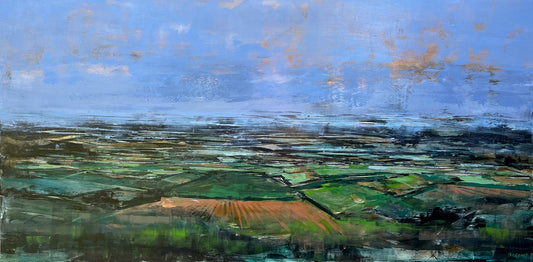
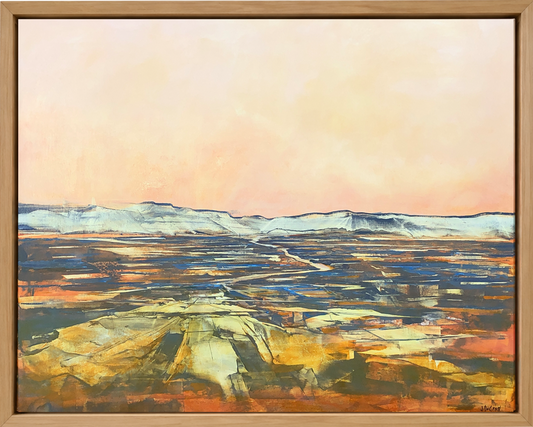
Her practice explores the emotional and psychological experience of landscape. Although rooted in the tradition of landscape painting, her approach is deliberately fictional. Her paintings occupy a space between the familiar and the imagined, drawing on remembered places, fragments of observation and thousands of photographs that she compulsively takes on any journey. These invented locations create landscapes that feel strangely recognisable without belonging entirely to any one place. They reflect an interest in the peculiar way memory alters the world: simplifying some details, intensifying others and filling the gaps with invention.
Jennie is interested in the way landscapes become repositories for memory. Her undergraduate degree in Archaeology was her introduction to narrative held in the landscape. Rather than attempting to faithfully reproduce a particular location, she constructs places from fragments of observation and recollection. These elements are brought together to create fictional landscapes that carry the atmosphere of somewhere remembered rather than somewhere precisely observed.
Her paintings are often quiet and psychologically charged. De Groot is interested in landscape not only as a physical environment, but as a site for projection, memory and emotion, a continuation of her locus of interest from her master’s degree.
The paintings frequently inhabit the uncertain hours of the day — the long stare of late afternoon, the fading light of evening, or the suspended atmosphere of a place before or after something has happened. This sense of temporal uncertainty allows the landscape to become less descriptive and more experiential. The viewer is invited to linger rather than simply identify the location.
The paintings are made slowly through a process of layering, editing and reworking. The slow drying nature of oil paint facilitates this delicate tango. Initial observations and photographic references provide a starting point, but the finished image develops through painting itself. Colour, light and spatial relationships are continually adjusted until the landscape acquires its own internal logic. The aim is not to arrive at a literal representation of a place, but at the feeling of recognising that place without quite knowing why. She refers to them as “ fictional places that feel familiar”.
At the heart of De Groot's practice is a question about what makes a landscape feel familiar. Her paintings suggest that our strongest sense of place may not come from geographical accuracy, but from the accumulation of memory, sensation and emotion.